


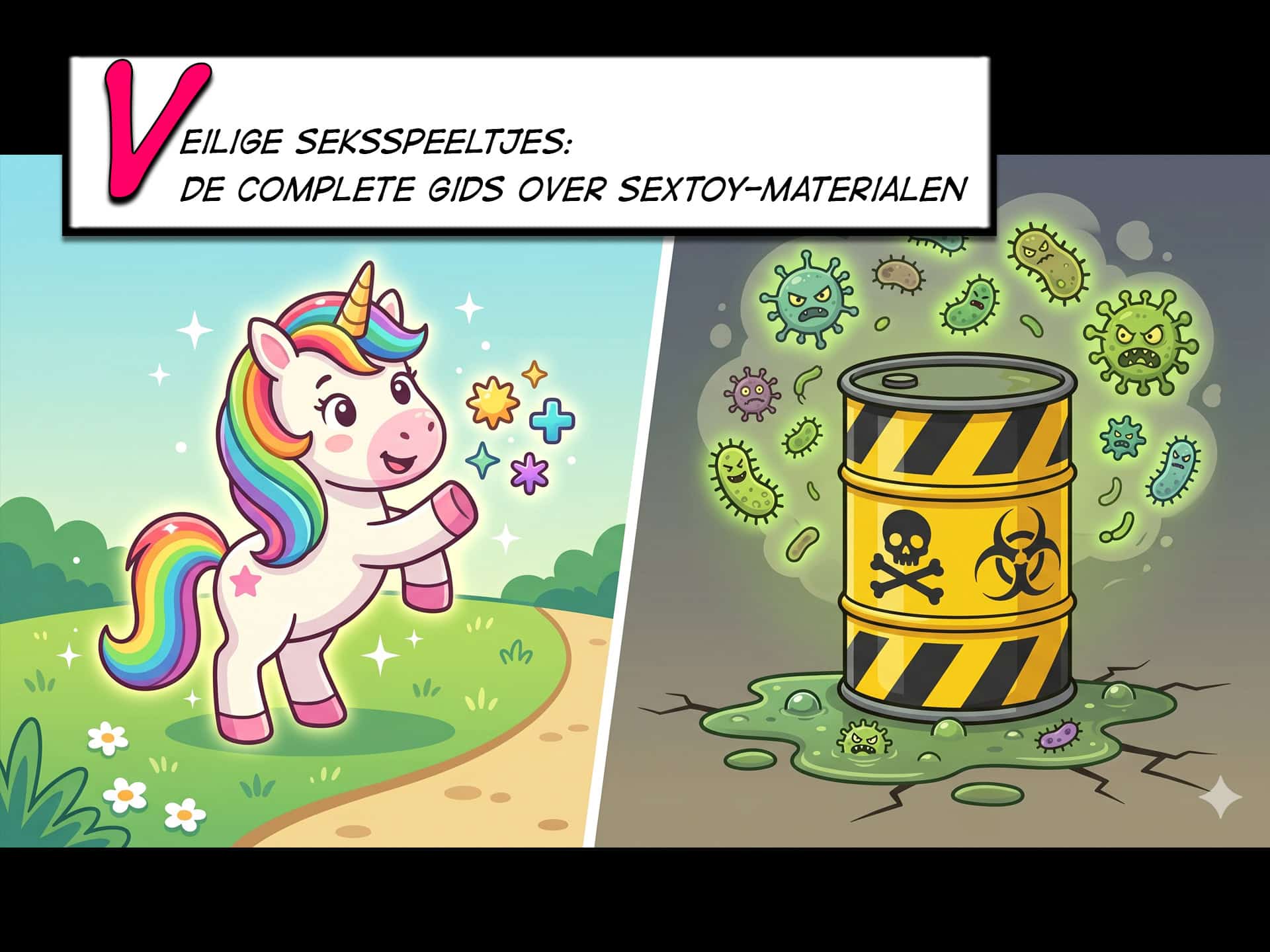
You wouldn't immediately think about it when you order a new vibrator or Dildo, but the material of your sex toy really makes a difference. Not only for how it feels, but also for your health. The sex toy market has grown tremendously, but regulations have not kept up with it for a long time. The result? There are just toys being sold from materials that irritate your body, can cause infections or, in the worst cases, release harmful substances.
In this guide we explain exactly which sextoy materials are safe, which ones are better to avoid, why certain popular materials are a problem, what the new international standard ISO 3533 means and what the current state of legislation is. No unnecessary panic, just honest and complete information.
Tesstesst and safe sex toys: from day one our thing
At Tesstesst, we have been committed to safe sex toys since the beginning of the website. We do this not only in our reviews (where we are always transparent about the material of every toy we test), but also by actively participating in broader conversations about safety in the industry. In 2021, for example, we participated in the process around ISO 3533, the first ever international standard specifically for sex toys. You can read all about that below.
We believe everyone has a right to honest information about what's actually inside their sex toy. Because if you don't know it yourself, who will tell you? The packaging? Which, as you will read shortly, is legally allowed to just lie.
No regulations? No, really not
In the Netherlands, and in most other countries, sex toys legally fall under "novelty products": consumer products for recreational use. That sounds innocuous, but concretely it means that manufacturers do not have to prove that their product is safe for internal use. There are no mandatory lab tests, no independent testing, no material certification.
This has a direct consequence: a manufacturer can have "silicone" printed on the label in China, when the product is not that at all. No one to stop it. Nothing on the packaging has to contain a shred of truth. Terms like "body safe," "medical silicone" or "phthalate-free" sound reassuring, but are not legally enforceable or verifiable.
That is not to say, by the way, that all toys are dangerous. Far from it. But it does mean that consumers should do their own homework. And that the text "For Novelty Use Only" that you see on many packages is not a safety warning but simply a legal escape route: if a product is classified as a curiosity instead of a medical device, it does not have to meet strict safety requirements.

What the lab tests told us: and what they just barely say
A number of independent lab tests have been conducted on sex toys over the years, and the results tell an interesting story of how the industry has changed.
Mid-2000s: the Danish Ministry of the Environment tested a large number of sex toys. The results were downright bad: high concentrations of phthalates and other harmful substances. At the same time, Smitten Kitten and Badvibes.org did the first systematic private lab tests in 2006. There, too: worrisome results.
2014: Smitten Kitten again sent a series of suspicious, porous toys to the lab. Surprising result: all toys tested were rated phthalate-free. Good news? Up to a point. Phthalates are not the only harmful substance that can be in toys, and "phthalate-free" does not automatically mean safe.
2017: Sweden's Kemikalieinspektionen published a study showing a significant decrease in dangerous chemicals in sex toys. Almost all the toys studied were found to be free of banned substances(PDF of the report).
Sounds like good news, right? But here's a catch: despite better test results, people continue to react to certain toys: chemical burns, irritations, rashes. Lab tests measure for known, banned substances. What else is in such a toy in terms of new chemicals, oils of unknown quality or volatile organic compounds (VOCs) released when the material breaks down is outside the standard test panel.
Conclusion: the industry has improved, but "phthalate-free" is not yet a final destination.
Two questions that determine everything
If you want to know if a toy is safe for internal use, there are really only two questions that matter:
- Is the material non-toxic? Does it not release harmful substances that enter your bloodstream through your mucous membranes?
- Is the material non-porous? Can't bacteria, mold and yeast settle in the material?
That second question is far too often forgotten. A porous toy can never really be cleaned, even with extensive washing. Microorganisms crawl into the pores and stay there. If you use the toy repeatedly, each time you reintroduce bacteria or mold into your body. That doesn't have to be toxic to cause problems: repeated fungal infections, bacterial vaginosis and other vaginal complaints can be directly related to porous toys.
And then there is a third factor that people underestimate: stability of the material. A toy that is not toxic now may be in a few months, namely when the material begins to break down, release oils and form new chemical compounds. This is not a theory; it's visible if you store cheap toys long enough.
What really happens to cheap toys: the melted-pot experiment
One of the most convincing demonstrations of material degradation is the so-called "melted jar" experiment, first set up by sex toy reviewers in the international community. The idea is simple: put several sex toys made of various materials together in a sealed jar and photograph the results over a period of months.
The results are confronting. Toys made of jelly, TPR and similar materials melt together, discolor dramatically, form oil puddles on the bottom and leave a sticky, chemical residue when touched. They merge with their own packaging. The odor released is pungent and chemical.
This is what those materials do over time: also while they are in your drawer, also while you are using them. Slower perhaps, but the process is the same. Volatile organic compounds (VOCs) are released as soon as the material begins to break down. Oils seep out. And then when you use the toy internally, those substances are in direct contact with the mucous membranes in your vagina or anus, places that absorb chemicals at lightning speed.
A nice detail: toys made of 100% silicone stored in the same conditions showed absolutely no change. No fusion, no discoloration, no odor. That's the difference.

Phthalates: what you need to know
Phthalates are the best-known culprits in the world of sex toys. They are a group of chemicals used as plasticizers in PVC and other plastics: without phthalates, PVC would be hard and brittle; with phthalates, it becomes soft and pliable. Exactly why they are so useful for cheap toys.
The problem: phthalates are endocrine disruptors. They disrupt your hormone balance and have been linked to reproductive problems, liver and kidney damage, and possible carcinogenicity with long-term exposure. Mucous membranes, such as those in the vagina and anus, also absorb substances much more efficiently than normal skin. Symptoms of acute exposure to high concentrations may include headaches, cramps, nausea and burning sensations.
But beware: phthalates are not the only concern anymore. Even if a toy is "phthalate-free": it may contain other harmful additives, oils of unknown quality or reaction products of material degradation that are not routinely tested. "Phthalate-free" is a starting point; we are not there yet.
How do you know if a toy contains phthalates? Honest answer: you can't tell from the outside. The only way to be sure is to choose materials that structurally do not require plasticizers, such as silicone, glass or metal.
Safe sextoy materials: yay!
Time for the good news. There are many great materials that are completely safe for internal use, easy to clean and long-lasting. These are the materials you can choose for safe sex toys without worry.
100% silicone: the gold standard
Silicone is the absolute winner. It is non-porous, hypoallergenic, chemically stable and lasts for years. Bacteria can't get a grip on it. You can sterilize it by boiling it (top rack dishwasher, no soap powder, or 5-8 minutes in boiling water) and it doesn't break down over time.
You'll also come across it as platinum silicone (which refers to the curing agent) or food-grade silicone. Both are excellent for use. "Medical silicone" sounds impressive, but for sex toys it is not actually necessary, and considerably more expensive to produce. A toy that claims to be made of "medical silicone" for a ridiculously low price? Eyebrows raised.
Most importantly, it must be 100% silicone. A "silicone blend" or "silicone mix" is not silicone. As soon as you add something else to it to make it cheaper, you lose the very properties that make it safe. More on that later.
Borosilicate glass

Glass is sturdier than you think, completely non-porous, easy to sterilize and great for temperature play. The most common type is borosilicate glass, the same material as Pyrex cookware, so already proven safe. A cheaper variant is soda lime glass, also safe, but slightly less resistant to sudden temperature changes.
Two points to be keen on:
- Tempering (annealing): Quality glass is treated by a long heating process that makes it extremely strong. Cheap brands skip this. Untreated glass is not immediately dangerously fragile, but is more fragile when bumped or dropped. You can test this at home: look through the glass with polarized lens glasses. Annealed glass shows a rainbow pattern; untreated glass does not.
- Painted glass: some cheap glass toys have a painted pattern. Always avoid: the paint is not meant for internal use and can come off. Colored glass (where the color is through the glass) is fine though.
Inspect your glass toy for cracks or crazing before each use. At the slightest damage: throw it away immediately. Genuine.
Medical grade stainless steel
Completely non-porous, sterilizable, hypoallergenic and basically lasts forever. It feels heavy and luxurious, heats up quickly to body temperature and is ideal for temperature play. Njoy is the most respected brand in this category, with products like the Pure Wand being a classic for years.
Aluminum
Aluminum is lighter than steel, but also completely safe, if provided with a body-safe powder coating. A less common material in the market but an excellent choice.
Glazed ceramics
Safe as long as it is glazed and fired at a high temperature in an oven. The glaze makes the surface non-porous. Ceramic toys are also very beautiful, ideal if you want to brighten up your bedside table as well.
ABS plastic
Non-toxic and you see it a lot in the hard casing of vibrators. It is somewhat porous, so sterilization is not possible. But for external use or if you don't share it, fine. Wash it well with soap and water after each use.
Wood (but only when properly finished)

May sound crazy, but it can be very safe, provided the finish coating is top quality. Wood itself is porous, but a good protective coating completely seals the surface. Always ask about the specifications of the coating before you buy.
Natural stone
Stone cannot be sealed, only polished. Porosity varies by stone type, and how those minerals behave with long-term internal use has not been well researched. For short-term use, it is probably not a problem, but it is a gray area. With stone, always choose a specialized maker who is transparent about the type of stone.
Sextoy materials to avoid
Jelly, Jellee, Gel and related products
The arch-villain of the sex toy world. Jelly feels soft to the touch, looks colorful, is spot on, but is full of problems. Almost always made of PVC with phthalates as plasticizers. Highly porous, breaks down over time, releases oils and volatiles and can literally fuse with its own packaging if you store it long enough. The possible consequences of use: irritation, chemical burns, repeated infections and, with prolonged exposure, possibly systemic effects of phthalate absorption. Not the deal it seems for a €8 toy.
PVC and vinyl
PVC and vinyl are the basic form of the problem; in fact, jelly is a variant of these. Same plasticizers, equally porous, breaks down. Highly avoidable for internal use.
Rubber and latex
Porous and potentially dangerous to people with latex allergies. Claims such as "skin-safe rubber" or "latex-free" on packaging have not been independently verified. Rubber also degrades quickly and is difficult to keep clean. There are better alternatives.
CyberSkin, UR3, FutuRotic, Fanta Flesh, NeoSkin and similar names
All are trade names for materials that should feel as realistic as possible. They succeed pretty well at that, but they are also highly porous, unstable and secrete oils. If a toy looks super realistic in texture, it is not a Fleshlight and it is not silicone: then you are probably in this category. Not suitable for repeated use.
TPE, TPR, elastomer, SEBS and "silicone blends"
The most nuanced category. TPE and TPR by themselves are not demonstrably toxic, but there are solid but-and's:
- Porous: Almost always porous enough to retain bacteria and mold. Non-sterilizable.
- Softened with mineral oil: Of unknown quality, may be released during use.
- Unstable: Starts to break down after a few months: cracks, black spots, strange smells. These are signals to throw the toy away.
- Unknown additives: In addition to phthalates, it may contain other harmful substances that are not routinely tested.
If you do use TPE/TPR: wash it thoroughly after each use, let it dry completely, never share it without a condom and replace it after a maximum of 8 to 10 months.
And that "silicone blend"? There is no such thing as a safe material. Silicone is a stable polymer. As soon as you add cheaper substances to it, you lose exactly the properties that make it safe and durable. Any "silicone blend" is just TPR or TPE with a more attractive label.
Sil-a-gel: a specific case to know
Sil-a-gel is not a material, but an additive: an antibacterial additive mixed into PVC toys. The claim: it inhibits bacterial growth in the pores. Sounds logical, but in practice, numerous users have reported severe chemical burns and irritation after using products containing this additive. There are no independent safety studies showing that Sil-a-gel is safe for internal use. The advice: avoid products containing Sil-a-gel entirely.
Overview: all sextoy materials in one table
| Material | Safe? | Porous? | Sterilizable? | Shelf life |
|---|---|---|---|---|
| 100% silicone | ✅ Yes | No | Yes | Years |
| Borosilicate glass | ✅ Yes | No | Yes | Years |
| Medical stainless steel | ✅ Yes | No | Yes | Lifetime |
| Aluminum (with coating) | ✅ Yes | No | Yes | Years |
| Glazed ceramics | ✅ Yes | No | Yes | Years |
| ABS plastic | ✅ Non-toxic | Light | No | Years |
| Wood (bodysafe coating) | ⚠️ Brand dependent | With coating: no | No | Years |
| Natural stone | ⚠️ Gray area | Yes | No | Years |
| TPE / TPR / elastomer | ⚠️ Non-toxic, hazards | Yes | No | 8-10 months |
| "Silicone Blend" / SEBS | ❌ Misleading label | Yes | No | Months |
| Jelly / Gel / Jellee | ❌ No | Strong | No | Months |
| PVC / vinyl | ❌ No | Strong | No | Months |
| Rubber/Latex | ❌ No | Yes | No | Months |
| CyberSkin / UR3 / Fanta Flesh etc. | ❌ No | Strong | No | Months |
| Sil-a-gel (additive in PVC) | ❌ No | Strong | No | Months |
ISO 3533: finally an international standard for sex toys
September 2021 marked a milestone: the publication of ISO 3533:2021, the world's first international standard specifically for sex toys. The full title: Sex toys: Design and safety requirements for products in direct contact with genitalia, the anus, or both. The standard was developed by the Swedish Institute for Standardization (SIS), based in part on Swedish hospital research showing that poorly designed sex toys were causing an increasing number of emergency room admissions. It is valid in 165 of the world's 195 countries.
We at Tesstesst welcomed this development, and we did our part in the process around it. But what does this standard actually say?
Material safety and biocompatibility
ISO 3533 requires manufacturers to establish a Restricted Substance List (RSL): a list of substances that should not be present in materials that come into contact with mucous membranes. The standard lists a series of substance groups that belong at least on that list, including phthalates, organotin compounds, polycyclic aromatic hydrocarbons (PAHs), bisphenol A, certain metals, N-nitrosamines, azo dyes and more.
In addition, materials that come into contact with mucous membranes must be demonstrably biocompatible. Manufacturers can demonstrate this by testing the finished product through the ISO 10993 series (biological evaluation of medical devices) or by using only materials already approved for food contact. Those tests must be performed by an accredited laboratory and reviewed by a toxicologist.
Design requirements for safe use
The standard also sets concrete design requirements. For example, anal toys must be designed so that they cannot be swallowed by the rectum. A clear base, flap or other mechanism that prevents this. And if a toy does get stuck, the design must allow medical personnel to remove it with standard instruments. The background for this is harsh: clinical research shows that in severe cases of jammed objects in some hospital series, up to 50% of patients required a laparotomy (abdominal surgery).
Products for genital enclosure, such as penis rings or chastity devices, should be safe to remove by the user himself, or else with common household tools such as pliers. They should never require power tools for removal. (A logical requirement, yet not obvious to everyone.)

Temperature, vibration and electrical safety
Toys with heating functions should preferably make the surface no warmer than 41°C and never warmer than 48°C, as tissue damage begins to occur above that. Vibrations should be evaluated for possible damage, and products with electrical stimulation should be found safe by a certified laboratory. In remote-controlled toys, the part in contact with the body should always have a clear, simple expand function.
User information: finally mandatory
Perhaps most recognizable to consumers: ISO 3533 requires manufacturers to specify on the packaging what material comes into contact with the genitals or anus. Not a vague claim, but the actual specification of the material. Also mandatory are: cleaning instructions, storage instructions, information about compatibility with other materials (think lubricants), warnings about when not to use the product, and, if the product contains latex, a clear latex statement.
Voluntary, but influential
Important to know: ISO 3533 is a voluntary standard. Manufacturers are not legally obligated to it unless a country or region incorporates the standard into its legislation. Still, the impact is significant: the standard gives buyers, retailers and testing laboratories a common language and a clear frame of reference. Manufacturers who can demonstrate compliance with ISO 3533 can list it on their packaging. This has now become a distinctive quality mark.
Current regulations in Europe: what has changed?
The advent of ISO 3533 stirred the industry, but on the legislative front, the situation in Europe is more nuanced.
The new EU General Product Safety Regulation (GPSR).
On Dec. 13, 2024, the new General Product Safety Regulation (GPSR, Regulation EU 2023/988) came into force across the EU, replacing the old General Product Safety Directive (GPSD) from 2001. This is good news for consumers because the GPSR has significant rules that the old directive lacked:
- Directly effective: The GPSR is a regulation, not a directive. That means it applies directly in all EU member states without national transposition. So there are no longer differences between countries in how strict enforcement is.
- Online marketplaces liable: platforms such as Amazon and AliExpress must register with the EU Safety Gate, must cooperate on recalls and share responsibility for the safety of products sold through their platform. This is a fundamental change.
- Faster recalls: In the event of a serious safety risk, incidents must be reported within two business days.
- EU responsible party required: Non-EU manufacturers must designate an EU-based party responsible for compliance. This makes enforcement a lot easier.
- Technical documentation required: Manufacturers must maintain technical documentation on the safety of their products.
But: there is no specific EU legislation for sex toys yet
Here's the honest message: sex toys fall under GPSR as ordinary consumer products, but there is still no sector-specific legislation in Europe requiring manufacturers to test for phthalates, biocompatibility or material transparency. In an answer to a parliamentary question in 2023, the European Parliament explicitly stated that sex toys "are not covered by EU rules" and only fall under general product safety.
ISO 3533 can indeed be used as a reference standard to demonstrate that a product meets the safety requirements of the GPSR, but that is a voluntary step by the manufacturer, not an obligation. The REACH regulation limits certain phthalates in plastics, but does not contain specific limits for sex toys as a product category.
In short, the situation has improved, but consumers are still not fully protected by legislation alone. Self-knowledge remains the best protection, which is exactly why we are writing this guide.
Myths that must be dispelled
Myth 1: "With a condom on, it's safe."
A condom reduces direct contact with the material, which already helps somewhat. But it doesn't fix the problem. Jelly materials and similar substances release VOCs that can migrate through the condom. Moreover, the material still breaks down. In the long run, a condom on an unsafe toy is not a structural solution. It is a band-aid on a wound. Better: just buy safe sex toys.
Myth 2: "Silicone melts when it comes in contact with other silicone"
Completely false for real silicone. What does merge are toys made of jelly or TPR that were sold as "silicone" but were not. Two toys made of 100% silicone lying side by side in a drawer for months? Absolutely no problem.
Myth 3: "If it smells, it's not silicone"
Not automatic. Silicone by itself has hardly any odor, but absorbs odors from its surroundings. A slight chemical smell upon arrival is not proof that it is fake. Wash it, let it air for a day. Does a strong rubbery or chemical smell remain present? THEN there is more reason for doubt.
Myth 4: "Phthalate-free = safe"
Phthalate-free means that the manufacturer claims to have added no phthalates. There is no independent verification, no legal liability if that claim is false, and phthalates are not the only potentially harmful substance. It is a starting point, nothing more.
Myth 5: "Silicone, silicon and silica gel are the same thing"
Absolutely not. Silicone (with -en) is the polymer material for sex toys. Silicon is a semiconductor for computer chips. Silica gel is the little white granules in the bags you find in shoe boxes. Sex toys are never made of silica gel, even though some questionable sellers claim they are.
Myth 6: "Translucent silicone does not exist"
True, transparent toys sold as "silicone" often are not: they are TPR or TPE. But transparent silicone does exist. Real transparent silicone has a matte, slightly milky undertone. TPR/TPE is brighter and feels stickier. In doubt? Do the flame test.
Myth 7: "'For Novelty Use Only' is a safety warning."
It isn't. It is a legal escape route by which manufacturers get out from under strict safety requirements by classifying their product as a "curiosity" rather than a medical device. It says nothing, absolutely nothing, about the quality or safety of the toy.
Self-testing: how do you know what you have in your hands?
Quick checks
- Feeling: Real silicone feels velvety, almost powdery. TPR feels stickier or oilier.
- Odor: Silicone has little odor. A strong chemical or rubbery odor is a warning signal.
- Price: 100% silicone costs more to produce. A "silicone" toy for €5 is almost certainly not real silicone.
- Brand and store: Are you buying from a specialized, reputable store? Then you can reasonably assume that their silicone products are actually silicone.
What if you get a reaction?
Burning sensation, irritation, rash or swelling during or after use? Stop immediately. Rinse affected area thoroughly with lukewarm water. No soap or perfume products on irritated skin. Cool gently. Does the complaint persist or worsen? Consult a doctor. Discard the toy and consider reporting it to the seller so they can take action with the manufacturer.
Buying safely: what to look out for?
Buy from specialized stores
The best guarantee of safe sex toys is buying from a specialized sex toy store that takes its products seriously. Good stores know their suppliers, know what materials are used and screen their assortment. They vouch for it with their name.
Consider, for example, stores we work with frequently, such as:
Large platforms: extra caution required
On platforms like Amazon and AliExpress, the risk of counterfeits, misleading labels and unknown manufacturers is significant. The new GPSR has imposed obligations around product safety on platforms like Amazon, but in practice, enforcement is complex and takes time. A fake-Lelo or fake-We-Vibe is identical on the outside, but made of completely different materials. If you do buy through such a platform: do thorough research on the specific brand and seller.
Brands that consistently score well
There are plenty of brands that consistently use 100% silicone or other safe materials. Think Tantus, LELO, We-Vibe, Lovense, Njoy (steel). Not an exhaustive list; there are more good brands, but these are names that consistently score well for years.
Cheap is expensive
100% silicone costs more to produce than jelly or TPR. A toy for €5 that claims to be made of "silicone": that's not true. A ridiculously low price is always a red flag when it comes to material quality.
Cleaning your sex toy: by material
- 100% silicone without motor: Boiling (5-8 minutes) or 10% bleach solution. For daily use: soap and water will do.
- Silicone with motor or electronics: wipe with damp cloth + soap or sex toy cleaner. Never submerge unless explicitly waterproof.
- Glass, stainless steel, ceramic: almost anything goes: cooking, dishwasher, disinfectant, soap and water.
- ABS plastic: Soap and water or sex toy cleaner. Do not boil, which corrodes the plastic.
- TPE/TPR: Wash thoroughly with soap and water after each use. Allow to dry completely. Never share without a condom. Replace after a maximum of 8 to 10 months.
Store your toys dry, preferably in a cloth bag or separate box, not loosely together in a drawer, especially if you have both silicone and TPR toys.
In summary: the rules of thumb for safe sex toys
- For internal use, always choose 100% silicone, glass, stainless steel or ceramic
- Avoid jelly, PVC, vinyl, rubber and CyberSkin-like materials entirely
- TPE and TPR are not toxic but they are porous and unstable. In fact, use it only for the penis and replace regularly
- A "silicone blend" does not exist as a safe material, always a misleading term
- Labels such as "phthalate-free" or "body safe" are not legally guaranteed
- ISO 3533:2021 is the first international standard for sex toys, a milestone, but not yet mandatory
- EU GPSR (December 2024) strengthens general product safety, but there is no specific sex toy legislation in Europe yet
- Buy from specialized stores, such as those found on our support tess tesst page.
- Clean your toys after each use and discard them at the first sign of cracks, stains or strange odors
- Having doubts about a toy you already have? Do the flame test
It sounds like a lot, but in practice it's not so bad: buy from a good store, choose a brand with a solid reputation, and stick to silicone, glass or metal for internal use. Then you'll immediately have most of the worries off the table.
Resources
Much of the information in this article is based on Dangerous Lilly's research, published at dangerouslilly.com/toxictoys. In addition, we consulted:
- ISO 3533:2021: Sex toys: Design and safety requirements for products in direct contact with genitalia, the anus, or both. International Organization for Standardization / Swedish Institute for Standardization (SIS), published Sept. 29, 2021. iso.org/standard/79631.html
- Regulation (EU) 2023/988: General Product Safety Regulation (GPSR), applicable Dec. 13, 2024. EUR-Lex summary
- European Parliament: Answer to parliamentary question on regulation of sex toys (December 2023). PDF
- Kemikalieinspektionen (Swedish Chemicals Agency): Tillsyn av sexleksaker (2017). PDF report
- Danish Environment Ministry: investigation into chemicals in sex toys (published via Tantus Inc.)
- Smitten Kitten / Badvibes.org: lab results sex toy tests (2006, reassessed 2014)
Jay is de persoon achter Tess Tesst die verantwoordelijk is voor het testen van, en schrijven over seksspeeltjes die gericht zijn op de penis en de prostaat.
Omdat Jay ook kinkster is zal hij van tijd tot tijd ook een review of artikel schrijven over Kink en BDSM en alles wat daar bij komt kijken
Buiten zijn talent voor testen en schrijven over seks, seksualiteit, BDSM en natuurlijk seksspeeltjes, is hij ook verantwoordelijk voor het technisch onderhoud, de marketing en nog veel meer andere zaken binnen Tess Tesst en veel andere websites van zijn klanten.

0 Comments